Herculaneum in Italy
Facts checked in November 2026 against the operator's sources.
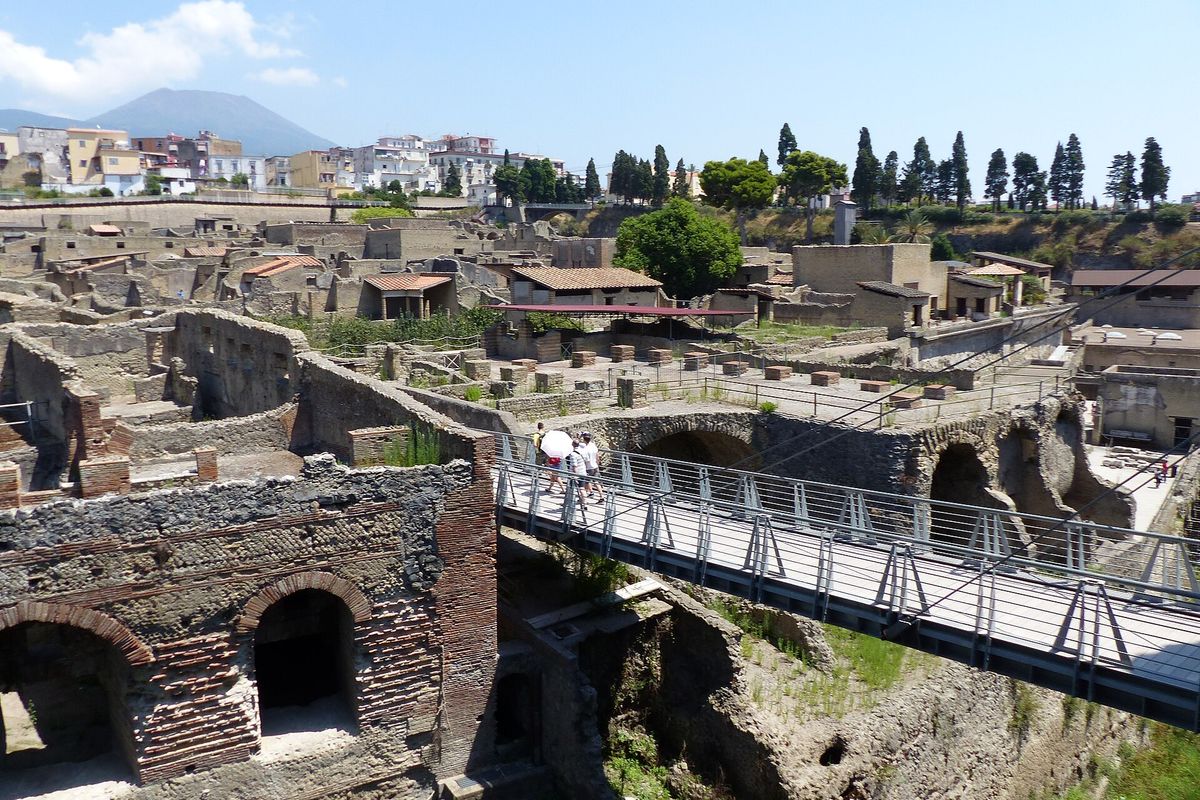
Herculaneum, Ercolano in Italian, is the Roman seaside town that Vesuvius buried under about 20 metres of volcanic material in AD 79. It lies 10 km south-east of central Naples, six minutes' walk from the Ercolano Scavi train station, and opens every day from 8:30. A standard ticket costs €16, under-18s go in free, and most visitors need about two hours. It is smaller than Pompeii but far better preserved: upper floors, carbonised wooden beams and mosaics are still in place.
Why Herculaneum is worth a visit
When Vesuvius erupted in AD 79, Pompeii was buried by falling ash and pumice. Herculaneum, on the western side of the volcano, met a different fate. According to the archaeological park, the town was hit first by surges of hot gas at around 400 °C travelling at more than 80 km/h, and then sealed under roughly 20 metres of volcanic deposits. That deep, hot burial is the reason the site feels so complete. Wood turned to charcoal instead of rotting, so you still see roof beams, door frames, a wooden partition, even furniture and food in the museum cases. Many houses keep their upper storey, something that is rare at Pompeii.
The town was small: around 20 hectares inside the walls and an estimated 4,000 inhabitants. Only a little over 4 hectares are excavated today, because the modern town of Ercolano is built directly on top of the rest. The result is a compact site you can see properly in a morning, with less walking and fewer crowds than Pompeii. Together with Pompeii and Torre Annunziata it has been part of a UNESCO World Heritage Site since 1997.
What you will see
- Houses of the local elite: courtyards, gardens and painted rooms, some opening onto terraces that once looked out to sea.
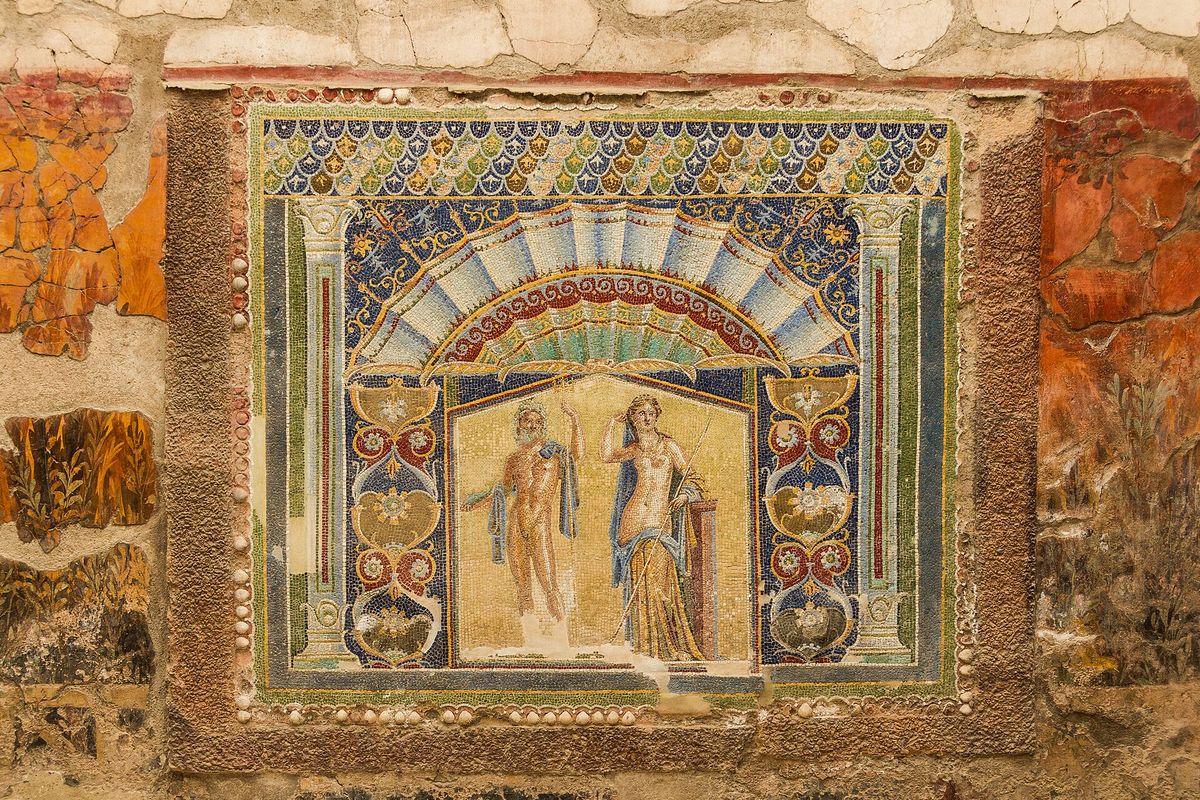
- The mosaic of Neptune and Amphitrite: a glittering glass-paste wall mosaic, one of the most photographed sights in the town.
- Baths: the Central Baths with separate men's and women's sections, and the Suburban Baths, among the best preserved bath buildings of the Roman world.
- Shops and taverns: counters with built-in jars, a bakery and workshops along the main street.
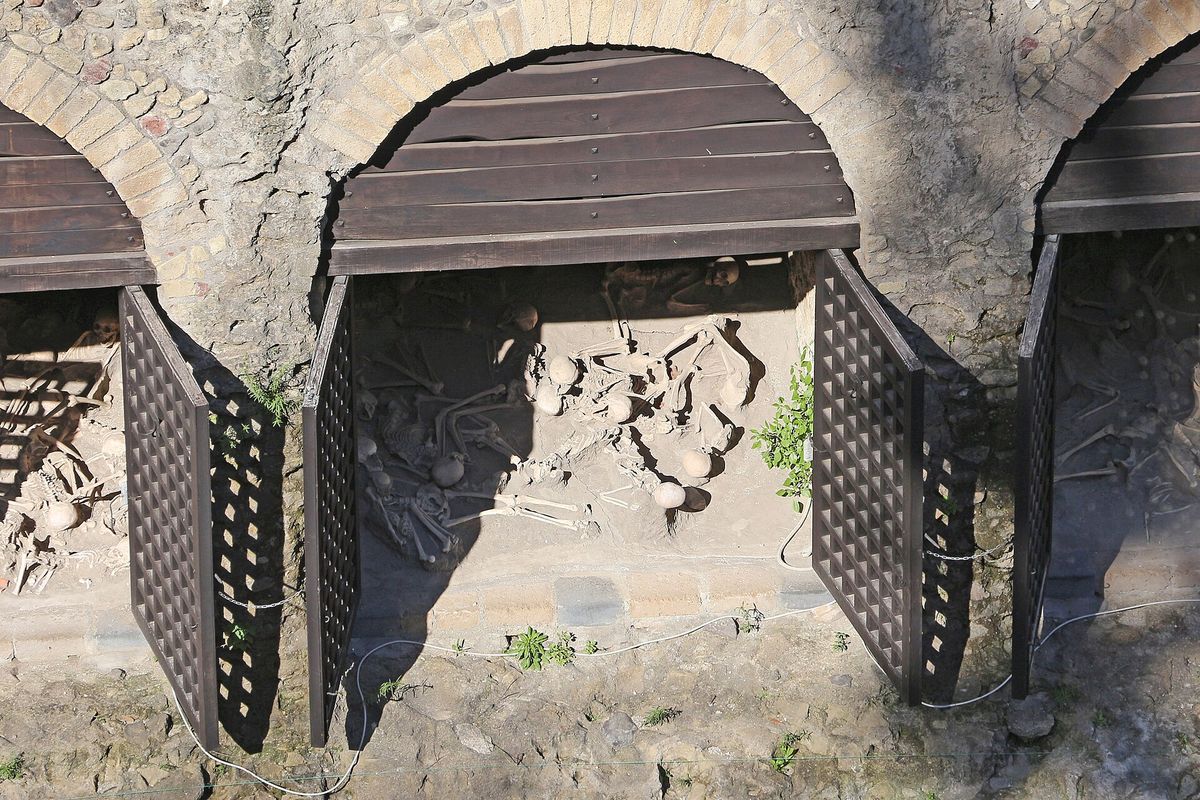
- The ancient shoreline: vaulted boat sheds where about 300 skeletons of people who tried to escape by sea were found from 1980 onwards.
- The Antiquarium and Boat Pavilion: statues, frescoes and everyday objects, plus a carbonised boat more than 9 metres long.
A note on names: Italians say Ercolano for both the modern town and the excavations, and timetables use Ercolano Scavi ("Herculaneum Excavations"). The official operator is the Parco Archeologico di Ercolano, part of the Italian Ministry of Culture. This site is an independent guide.
Ticket options and prices 2026
Prices from the park's tickets page as of November 2026. A ticket allows one entry on the day of the visit: once you leave, you cannot go back in with the same ticket.
| Ticket | Who it is for | Price |
|---|---|---|
| Standard | Adults aged 25 and over | €16 |
| Reduced | Young people aged 18–24 | €2 |
| Free | Under 18s and other groups set by Italian law | €0 |
| Free days | Everyone, first Sunday of the month, 25 April, 2 June, 4 November | €0, at the ticket office only |
| Online booking | Pre-sale charge on paid tickets | + €1.50 |
| Annual pass | One person, 365 days from first use | €30 |
| Family annual pass | Two adults and their children | €58 |
Source: Parco Archeologico di Ercolano, tickets page. There is no combined ticket with Pompeii.
For most visitors the decision is simple. If you are travelling as a family, you probably pay only for the adults: a couple with two teenagers spends €32 at the gate, or €35 online with the booking charge. Buying in advance makes sense in spring, at Easter and in summer, when the queue at the ticket office on Corso Resina can be long. Booking through a reseller such as GetYourGuide usually costs more than the face value, but it can bundle the entry with a guide, an audio tour or transport from Naples. The full comparison is on our tickets and prices page.
Opening hours at a glance
The park is open seven days a week. From 16 March to 14 October the gates open at 8:30 and close at 19:30, with last entry at 18:00. From 15 October to 15 March the hours are 8:30 to 17:00, with last entry at 15:30. The only fixed closing day is 25 December. The excavations themselves have to be left a little before the gates close, so do not plan to arrive in the last half hour. Mornings are cooler and quieter; tour groups from Naples and the cruise port tend to arrive mid-morning. Details by month are on the opening hours page.
Getting there in brief
The easiest way is the Circumvesuviana train on the Naples to Sorrento line. Get off at Ercolano Scavi, walk straight down the road towards the sea, and you reach the entrance at Corso Resina 187 in about six minutes. From Napoli Garibaldi the ride takes about a quarter of an hour. Pompeii is on the same line, about 20 minutes further on, so the two sites can be combined. Drivers leave the A3 motorway at the Ercolano Scavi exit; the park has no car park of its own, but the town runs one on Via dei Papiri Ercolanesi. See how to get to Herculaneum for times, tickets and the airport route.
Guides to plan your visit
Herculaneum or Pompeii?
Many travellers based in Naples or Sorrento have time for only one site. The two are very different experiences, and the honest answer depends on what you want from the day.
- Size and time: Pompeii is a whole city where you can walk 8 to 10 km in a day. Herculaneum is a neighbourhood you can see in about two hours, which suits families, hot days and short stays.
- Preservation: Herculaneum wins. Wooden beams, upper floors, colours and mosaics survive better, and you can look down on the town from above as you arrive.
- Big public monuments: Pompeii wins. It has the Forum, two theatres and the amphitheatre. At Herculaneum the public centre is still buried, and the underground theatre is currently closed.
- Crowds: Pompeii received more than four million visitors in 2024 and now caps daily numbers. Herculaneum is much calmer.
- Price: €16 here against €20 for the basic Pompeii ticket. There is no joint ticket, so seeing both costs €36 per adult.
If you can, do both: Herculaneum first thing in the morning, lunch, then Pompeii in the afternoon. In summer, with last entry at Pompeii at 17:30, that is a full but manageable day.
Herculaneum in numbers
- AD 79: the year of the eruption that buried the town.
- About 20 metres: the depth of volcanic material over the ruins, which is why the site lies in a deep pit below the modern street.
- 1710: the first Bourbon excavations, carried out through shafts and tunnels. Open-air digging followed from 1828, and the archaeologist Amedeo Maiuri uncovered most of today's visible town between 1927 and 1958.
- About 300: skeletons found on the ancient beach, a unique record of the people who lived here.
- Over 9 metres: the length of the carbonised boat in the Boat Pavilion.
- €16: the standard entry ticket, with no booking required on most days.
How long to plan
The park itself says a visit takes about two hours. Add 30 to 45 minutes if you want to see the Antiquarium and the Boat Pavilion properly, and the same again if you stop for a break on the Vesuvius terrace or in the shaded garden of the House of the Telephus Relief. A half day from Naples, door to door, is realistic.
Your visit step by step
- Choose the day
Avoid the free first Sunday of the month unless you are happy to queue: on free days nothing can be booked online. Weekday mornings are the quietest.
- Book or buy at the gate
Book online if you travel at Easter or in summer. Foreign visitors type EE1 in the Italian tax code field of the official booking form. Have the QR code ready on your phone.
- Take the train
Circumvesuviana towards Sorrento, get off at Ercolano Scavi. Check the timetable: not every train stops there.
- Leave big bags at the entrance
Backpacks, umbrellas and suitcases are not allowed inside. Left luggage is free.
- Walk down the ramp
The recommended route goes down the ramp into the excavations and back up over the bridge reached from Cardo III. Follow our two-hour route.
- Finish at the shoreline and museum
End with the boat sheds, the Antiquarium and the Boat Pavilion, then walk back to the station or continue to Pompeii or Vesuvius.
Practical tips that save time and money
- Bring water and a snack. There is no restaurant inside, only vending machines near the entrance bridge and a drinks and snacks point on the Vesuvius terrace. Since you cannot leave and re-enter, plan lunch for afterwards.
- Wear closed shoes. The ancient streets are uneven and the park advises against heels and flip-flops.
- Check what is closed. The Villa of the Papyri and the underground Ancient Theatre are closed for works with no reopening date. A tour that promises either is using outdated information.
- Dogs are welcome on a lead, but must be carried in the museum rooms and in houses with mosaic floors.
- Accessibility: an accessible route is marked in blue on the official map, and from November 2026 the park lends wheelchairs free of charge at the ticket office while stocks last.
More advice, including heat in July and August and visiting with children, is on our visitor tips page. If you prefer to be guided, the guided tours page compares the park's own tour, private guides and day trips from Naples and Sorrento.
Frequently asked questions
How much does it cost to visit Herculaneum?
A standard ticket costs €16. Young people aged 18 to 24 pay €2 and under-18s enter free. Online booking adds a €1.50 pre-sale charge on paid tickets.
Is Herculaneum better than Pompeii?
It is better preserved and much less crowded, and you can see it in about two hours. Pompeii is far larger and has the big public monuments. If you have one morning, Herculaneum is the easier choice.
How do I get to Herculaneum from Naples?
Take the Circumvesuviana train on the Naples to Sorrento line to Ercolano Scavi, about a quarter of an hour from Napoli Garibaldi. The entrance is a six-minute walk downhill from the station.
Do I need to book in advance?
Not usually outside the busy season, as you can buy at the ticket office. At Easter, on bank holidays and in summer, booking online saves queuing.
Is there a combined ticket for Pompeii and Herculaneum?
No. The official FAQ says each site sells its own ticket. Seeing both costs €16 plus €20 for the basic Pompeii ticket.
When is Herculaneum free?
On the first Sunday of every month and on 25 April, 2 June and 4 November. Free tickets are collected on the day at the ticket office; they cannot be booked online.
What are the opening hours?
8:30 to 19:30 from 16 March to 14 October (last entry 18:00) and 8:30 to 17:00 from 15 October to 15 March (last entry 15:30). It is closed on 25 December.
Can I see the Villa of the Papyri?
Not at the moment. The park lists the Villa of the Papyri as closed for excavation and accessibility works, with no reopening date. The underground theatre is closed too.
Is there food inside the site?
There is no restaurant. You will find vending machines near the entrance bridge and a drinks and snacks point on the Vesuvius terrace.
Can I combine Herculaneum and Vesuvius in one day?
Yes. Shuttle buses to the crater leave from the square by Ercolano Scavi station. Crater tickets are sold online only and the summit can close in bad weather, so book that part first.