What to see in Herculaneum
Facts checked in November 2026 against the operator's sources.
Herculaneum is compact: four complete blocks of houses, two eastern blocks with the palaestra and the Suburban Baths, the ancient shoreline and a small museum. In about two hours you can walk all the main streets, see the famous mosaic of Neptune and Amphitrite, the baths and the boat sheds, and finish at the Antiquarium and the Boat Pavilion.
Before you start
The park's recommended route enters the excavations down a long ramp and leaves over the bridge reached from Cardo III. From the ramp you get the best overview of the town: you are looking down into a pit, with the modern houses of Ercolano directly on the edge. Streets run in a grid. The decumani run parallel to the old coastline, the cardines run down towards the sea, and they divide the town into rectangular blocks. Which individual houses are open changes from day to day because of conservation work, so treat the list below as a guide, not a promise.
The route in six stops
1. Cardo III and the houses near the entrance
The first street you walk along gives the best idea of what makes Herculaneum special. Look up: many houses keep their upper floor and you can see original wooden lintels and beams, turned to charcoal by the heat. Some houses still have a wooden partition or a wooden staircase.
2. The House of Neptune and Amphitrite
Behind a shop with its counter and storage shelves lies a small courtyard with the town's most famous artwork: a wall mosaic of the sea god Neptune and his wife Amphitrite in brilliant blue and green glass tesserae, next to a mosaic fountain. Go early, as this house is on every tour.
3. The Central Baths
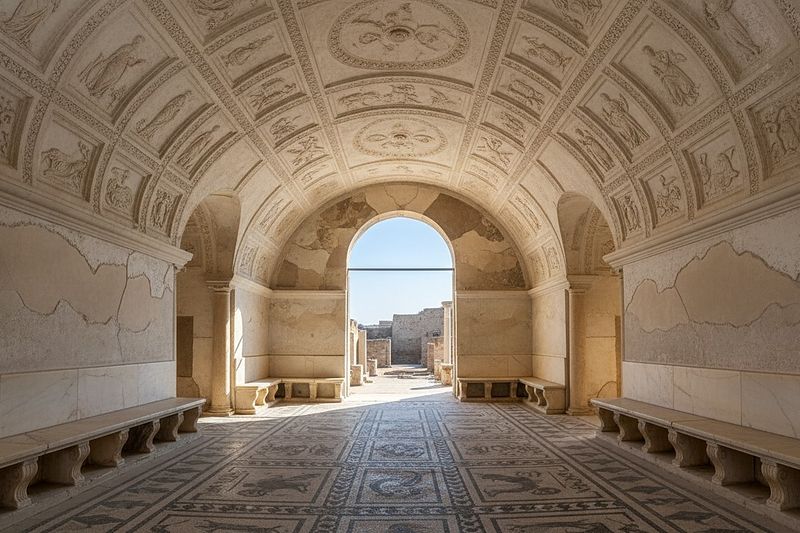
The public baths were split into a men's and a women's section, each with changing room, warm room and hot room. The mosaic floors and the vaulted ceilings are well preserved, and you can still see the niches where bathers left their clothes.
4. The Decumanus Maximus
The main street is wide and lined with shops, a fountain and the College of the Augustales, the seat of the priests of the emperor cult. Beyond it the town is still buried under modern Ercolano, including the Forum area and the Basilica of Nonius Balbus, which were explored only through Bourbon tunnels.
5. The terrace and the ancient shoreline
At the southern edge of the town, the terrace holds the Sanctuary of Venus and the funerary altar and statue of Marcus Nonius Balbus, the town's great patron. Below it, in the vaulted boat sheds that once opened onto the beach, archaeologists found about 300 skeletons from 1980 onwards: men, women and children who had fled to the sea hoping for rescue. Next to them lay jewellery, coins, house keys and even a surgeon's kit. It is a moving place, and with children it helps to explain beforehand what they will see. The Suburban Baths, one of the best preserved bath buildings of the Roman world, stand beside the shoreline; they are opened inside only during special guided visits.
6. The Antiquarium and the Boat Pavilion
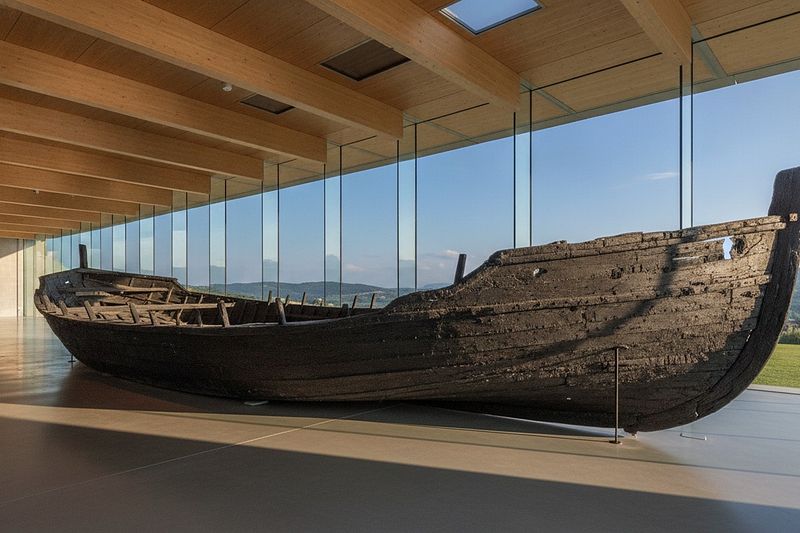
Allow 30 to 45 minutes for the two small museums. The Antiquarium, opened in 2018, shows the statue of Marcus Nonius Balbus, the bronze Hydra of Lerna, marble sculptures from the garden of the House of the Deer, frescoes from the Villa of the Papyri and the objects found with the fugitives. The Boat Pavilion holds a carbonised boat more than 9 metres long, found in 1982 in front of the Suburban Baths. One theory is that it was a military launch from Pliny the Elder's fleet, sent from Misenum to rescue the inhabitants.
What you cannot see at the moment
The Villa of the Papyri, the huge villa where a library of carbonised papyrus scrolls was found, is closed for excavation and accessibility works with no reopening date. The Ancient Theatre, which was reached through underground Bourbon tunnels, is also closed until further notice. The best way to see finds from the villa is the Antiquarium and the National Archaeological Museum in Naples.
If you have more or less time
- One hour: ramp, Cardo III, House of Neptune and Amphitrite, Decumanus Maximus, exit.
- Two hours: the full route above.
- Three hours: add a break on the Vesuvius terrace or in the garden of the House of the Telephus Relief, and use the park's 3D audio guide app for every house.
Frequently asked questions
What is the most famous thing in Herculaneum?
The wall mosaic of Neptune and Amphitrite and the carbonised wooden structures. The boat sheds with the fugitives' skeletons are the most moving part.
How long does it take to see Herculaneum?
About two hours for the town, according to the park, plus 30 to 45 minutes for the Antiquarium and the Boat Pavilion.
Are the skeletons still there?
The skeletons were found in the boat sheds on the ancient shoreline, which you see from the visitor path. Objects found with them are in the Antiquarium.
Is the Villa of the Papyri open?
No. It is closed for works and the park has not set a reopening date.
Is there an audio guide?
Yes, a 3D augmented-reality audio guide app for iOS and Android, also available to rent on site.